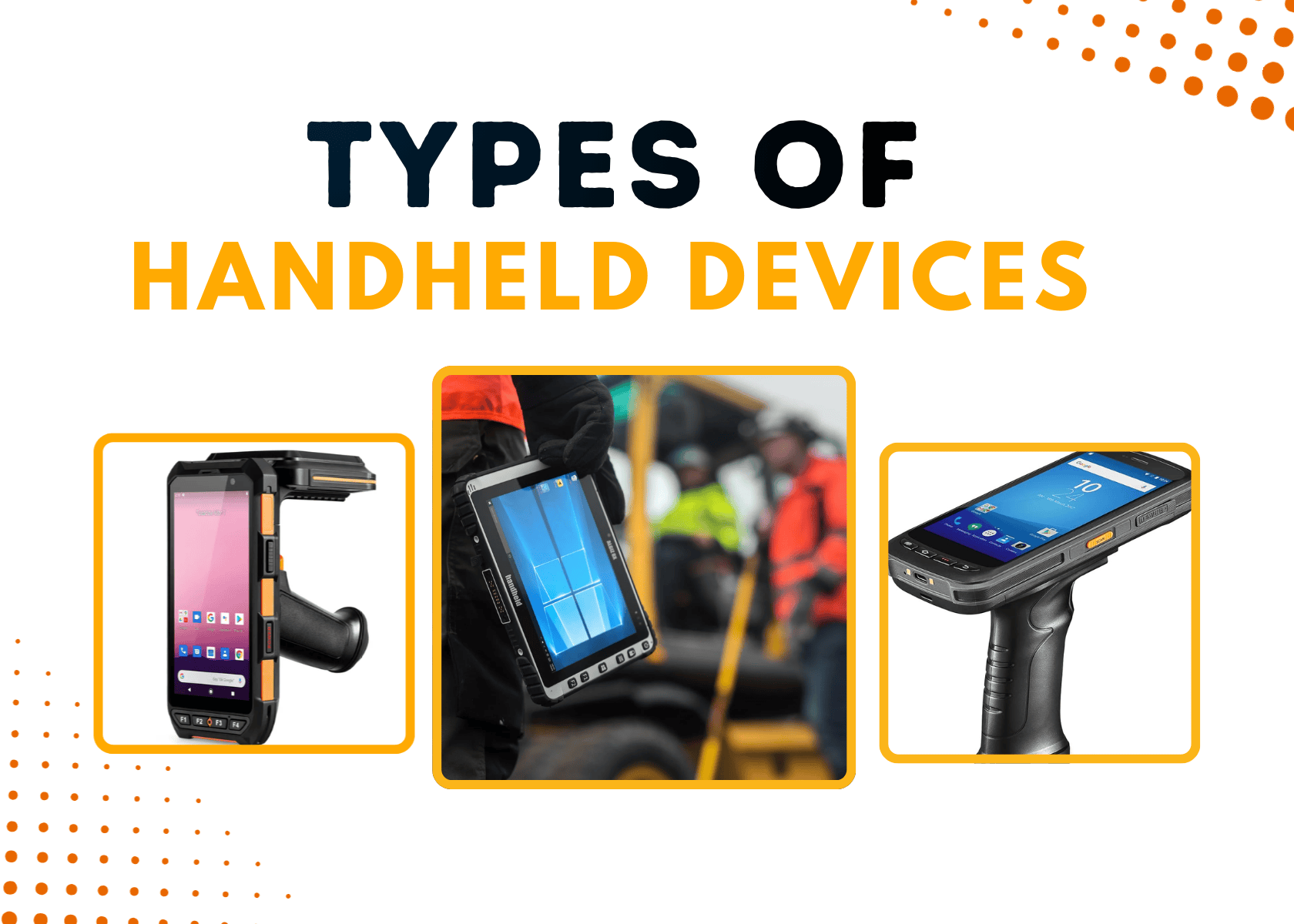
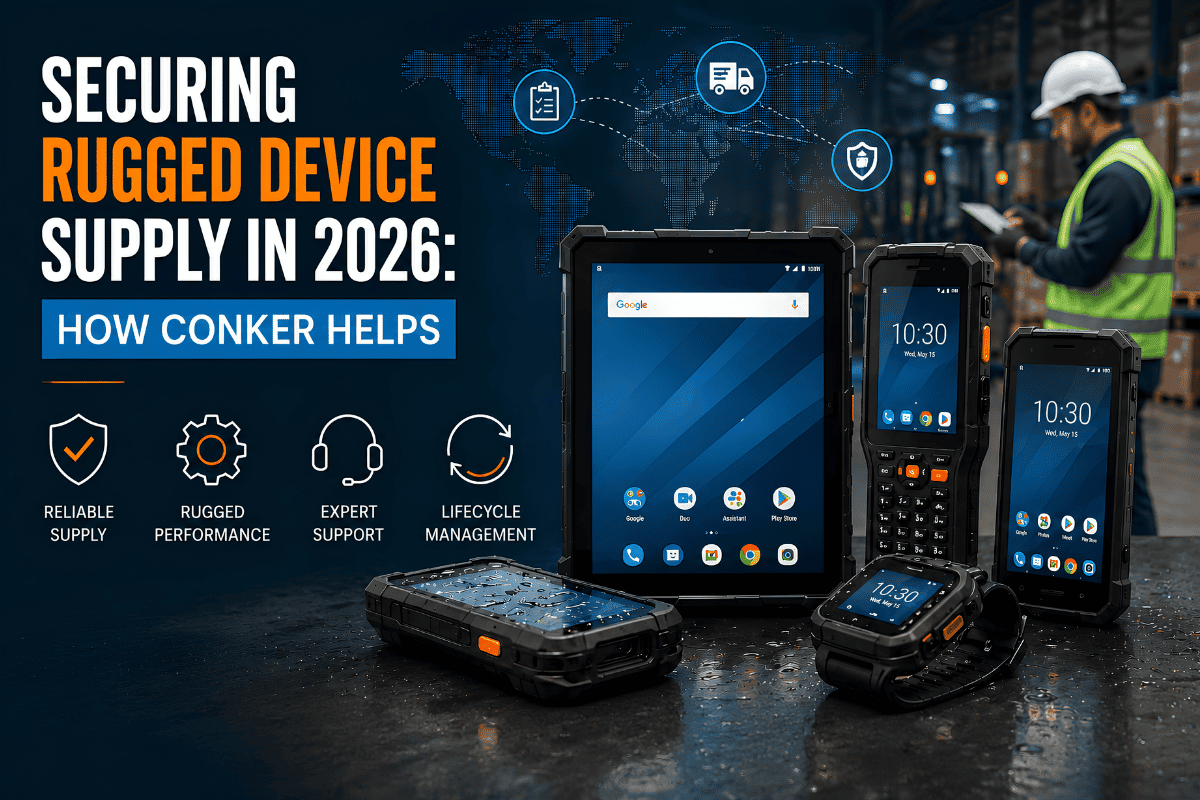
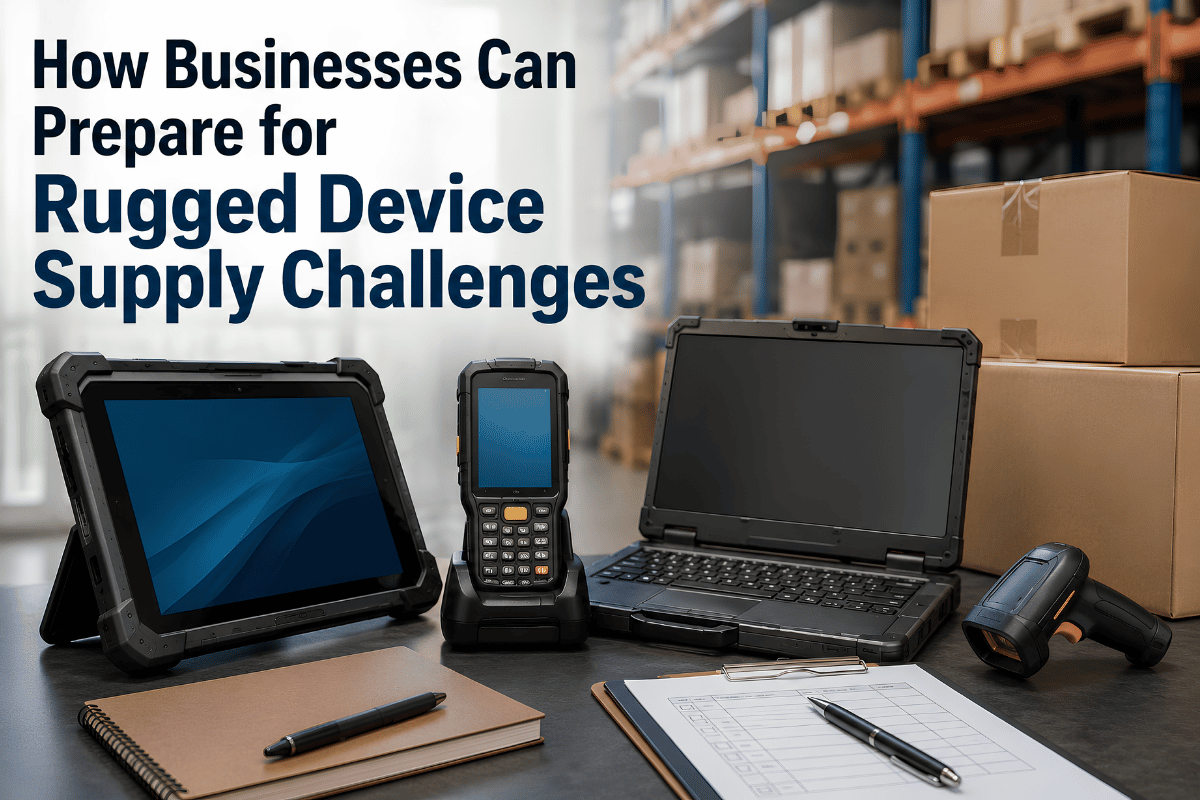
For most warehouse jobs, a rugged tablet costs less to run than a consumer tablet, even though it costs more to buy. Apple designs the iPad for use between 0°C and 35°C, consumer tablets have no built-in barcode scanner, and VDC Research data published by Dell in December 2025 shows non-rugged devices failing three times as often as rugged ones. A consumer tablet still works well for a supervisor's desk or a dashboard in a heated office.
On this page:
- What is the difference between a rugged tablet and a consumer tablet?
- What does a warehouse do to a consumer tablet?
- Isn't a protective case enough?
- Can a consumer tablet scan barcodes well enough?
- How much does a consumer tablet cost to run in a warehouse?
- When does a consumer tablet make sense?
- Which Conker rugged tablet fits which warehouse job?
- What happens when a rugged tablet breaks?
- Six questions to answer before you buy
- Frequently asked questions
What is the difference between a rugged tablet and a consumer tablet?
From the outside, the gap looks like a thicker case. Inside, the two devices are built for different jobs.
Manufacturers design a consumer tablet, such as an iPad or a Samsung Galaxy Tab, for a sofa, a classroom or a meeting room. They optimise it for weight, screen quality and price, and they replace the model roughly every year.
We design a rugged tablet for a shift. Conker's current Android, Windows and Linux tablets are sealed to IP68 against dust and water. Most carry a dedicated 2D barcode scan engine. They fit desk docks and lockable vehicle mounts, and they stay in production long enough for you to order the same model again two years later.
The table compares the two on the points warehouse teams ask us about most.
| Consumer tablet | Conker rugged tablet |
Dust and water | No current iPad carries an IP rating. Some Android models, such as Samsung's Galaxy Tab S series, are IP68. | IP68 across the current tablet range |
Drops onto concrete | No published drop standard. Protection depends on an add-on case. | Drop-tested and rated to MIL-STD-810 for shock and vibration [insert drop height per model] |
Operating temperature | iPad: 0°C to 35°C, per Apple | [insert range from datasheets] |
Barcode scanning | Camera plus a scanning app | Newland 2D scan engine built into the SX88, SX107, SX108, NS88, NS108, LX88 and LX108 |
Battery | Sealed, not user-replaceable | Up to 20,000mAh on the SX107. User-swappable on the SX10. |
Ports and docking | Usually one USB-C port | RJ45, HDMI, USB-A and 3.5mm on the SX88 and SX108. Desk dock with RS232 serial. Lockable vehicle mount. |
Weight | iPad 11-inch: about 480g | 480g (SX87) to 1,190g (SX108) |
Repairs | Retail repair or a replacement device | UK repair centre. Average repair time under one working day in 2024. |
Warranty | Apple: one year as standard, accidental cover through AppleCare+ at extra cost | Three years, with accidental damage cover on RELAX Plus |
What does a warehouse do to a consumer tablet?
Follow one tablet through a shift. It goes from a charging shelf into a picker's hand, onto a trolley, into a forklift cradle and back again. Every handover is a chance to hit a concrete floor.
Four conditions do most of the damage.
Drops. Concrete doesn't give. A case can stop the glass cracking, but the shock still reaches the board, the battery connector and the charging port.
Vibration. A tablet on a reach truck shakes for the whole shift over floor joints and dock plates. Consumer tablets aren't tested for this. Rugged tablets are tested to MIL-STD-810 for shock and vibration.
Dust and moisture. Cardboard fibre, pallet debris and washdown spray find their way into open charging ports and speaker grilles.
Cold. Apple states that iPads are designed for ambient temperatures between 0°C and 35°C, and that cold can shorten battery life or turn the device off. Frozen storage often runs at around -20°C to -25°C. A chiller at 2°C to 5°C sits at the very bottom of Apple's range, and carrying a cold tablet back into a warm loading bay draws condensation into the case.
Isn't a protective case enough?
A good case fixes cracked screens. It doesn't seal the charging port, add a scan engine, make the battery swappable or widen the temperature range.
A heavy-duty case also adds bulk, so the weight advantage you bought the consumer tablet for shrinks. If your tablets sit on a desk and get knocked off now and then, a case is a fair choice. If they ride on forklifts and go into the chiller, you're asking the case to do a job it wasn't designed for.
Can a consumer tablet scan barcodes well enough?
For a few scans a shift, yes. Camera scanning apps read clean labels in good light.
They slow down when labels are creased, wrapped in shrink film, printed small or sitting on a top shelf in poor light. The operator has to hold the tablet steady, wait for the camera to focus and line up the code. Multiply that by a few hundred picks and the delay shows up in your pick rate.
A dedicated scan engine reads the code when the operator presses a hardware trigger, with no camera app to open. Conker's SX and NS tablets use Newland 2D engines.
If your team scans hundreds of items an hour, a tablet may be the wrong form factor altogether. Our guide to the top rugged handheld PDAs for warehousing and our comparison of glove scanners and ring scanners cover the alternatives.
How much does a consumer tablet cost to run in a warehouse?
The purchase price is the smallest part of the bill. In a December 2025 analysis based on VDC Research's cost model, Dell reported that non-rugged devices fail three times as often as rugged devices, that each incident costs a worker 74 minutes, and that rugged notebooks and tablets cost 30% to 40% less over five years.
Here's how that plays out on a fleet of 40 tablets over three years. VDC's mobile device TCO research puts first-year failure rates at 10% to 23% for non-rugged devices and 4% to 7% for rugged ones. Applying those rates each year is a simplification, but it gives a useful range.
40 tablets, 3 years | Consumer tablets | Rugged tablets |
Annual failure rate (VDC) | 10% to 23% | 4% to 7% |
Failures over three years | 12 to 28 | 5 to 8 |
Working time lost at 74 minutes per failure | 15 to 35 hours | 6 to 10 hours |
The lost hours look modest on their own. The larger cost sits behind them: 12 to 28 replacement devices, each needing setup and enrolment, plus the orders that wait while a picker works without a device.
Conker's own figure is lower than VDC's rugged range. Across our devices, we record a 1.5% failure rate over three years. On a 40-tablet fleet, that works out at less than one device.
Model life matters too. Consumer tablets change every year or so. Order ten more next year and you may get a different model, a different case and a different OS version, which is how warehouses end up running mixed device fleets that IT has to support model by model.
Your own numbers will differ from these. The Conker TCO calculator lets you enter your fleet size, prices and failure history.
When does a consumer tablet make sense?
A rugged tablet isn't the right buy for every role in the building.
A consumer tablet works well for a shift manager in a heated office, a wall-mounted dashboard in a climate-controlled area, or a short pilot of new software before you commit to a full rollout. If the device never touches the warehouse floor, you pay for protection you won't use.
Weight is the other trade-off. Our 10-inch and 11-inch rugged tablets weigh between 1,080g and 1,190g, more than twice an iPad 11-inch. An operator holding one for a full shift will feel the difference. You can solve this with a hand strap, a vehicle mount, or a lighter model: the Conker SX87 weighs 480g, about the same as an iPad, and is still sealed to IP68.
Which Conker rugged tablet fits which warehouse job?
Forklifts and reach trucks. The SX88 (8-inch) and SX108 (10-inch) fit a lockable vehicle mount with a VESA plate. The mount's 8-pin aviation ports carry power and serial on one connector, USB and LAN on the other. For a fixed screen on the truck, see our vehicle mounted PCs.
Goods-in and picking on foot. The SX87 suits operators who carry the tablet all shift. Choose the SX88 if you need a built-in scan engine at 8 inches.
Multi-shift sites. The SX107 carries a 20,000mAh battery. The SX10 has a user-swappable battery, so a device can stay in service while a spare charges.
Windows warehouse software. The NS88 and NS108 run Windows 11, with Celeron or Intel Core i5 options. If your system runs on Ubuntu, the LX88 and LX108 share the same hardware platform.
High-volume scanning. A handheld often beats a tablet here. Our Zebra TC27 vs Conker SX65 comparison covers the choice.
You can see the full range on the rugged tablets page and our Warehouse & Distribution page.
What happens when a rugged tablet breaks?
Every Conker tablet comes with a three-year RELAX warranty.
RELAX Plus covers accidental damage with zero surcharges. We collect the device, repair it at our UK repair centre and return it, and we cover battery faults and degradation for the full three years. Our average repair time in 2024 was under one working day. That is a measured average, not a guaranteed SLA.
RELAX 360 adds on-site device swap-outs, device commissioning, end-of-life disposal with secure wipe, and a priority SLA.
To manage the fleet day to day, Conker MDM starts at £3.75 a month and covers kiosk mode, OS update control, remote lock and location tracking.
Six questions to answer before you buy
- What is the coldest, wettest or dustiest place the tablet will go?
- How many scans does one operator make in an hour?
- Will the tablet be carried, mounted, or both?
- How long is the longest stretch without a charger?
- Which operating system does your warehouse management system need?
- Will you need to order the same model again in two years?
If you'd like a second opinion on your answers, book a project scoping call. We'll match you with a consultant who works with warehouse and distribution sites.
Frequently asked questions
Can you use an iPad in a cold store or freezer?
Apple designs iPads for ambient temperatures between 0°C and 35°C. Below that range, battery life drops and the device can turn off. Frozen storage at around -20°C to -25°C sits well outside the range, and moving between cold and ambient areas causes condensation.
Does a warehouse tablet need an IP68 rating?
IP65 protects against dust and water jets, which covers a dry, ambient warehouse. IP68 adds protection against immersion. Choose IP68 for washdown areas, chillers where condensation forms, and outdoor yards. Conker's current tablets are all IP68.
How long does a rugged tablet last?
Conker covers its tablets for three years under the RELAX warranty, and the Dell analysis of VDC data compares costs over five years. Model availability matters as much as durability, because it decides whether you can add matching devices later.
Can you manage rugged tablets with MDM?
Yes. Conker's tablets run Android, Windows or Linux and work with standard MDM tools. Conker MDM starts at £3.75 a month and includes kiosk mode, OS update management and remote lock.
Do rugged tablets run the same apps as consumer tablets?
Yes, within the same operating system. An Android rugged tablet runs Android apps, and a Windows rugged tablet runs Windows software, including desktop warehouse management systems that won't run on an iPad.