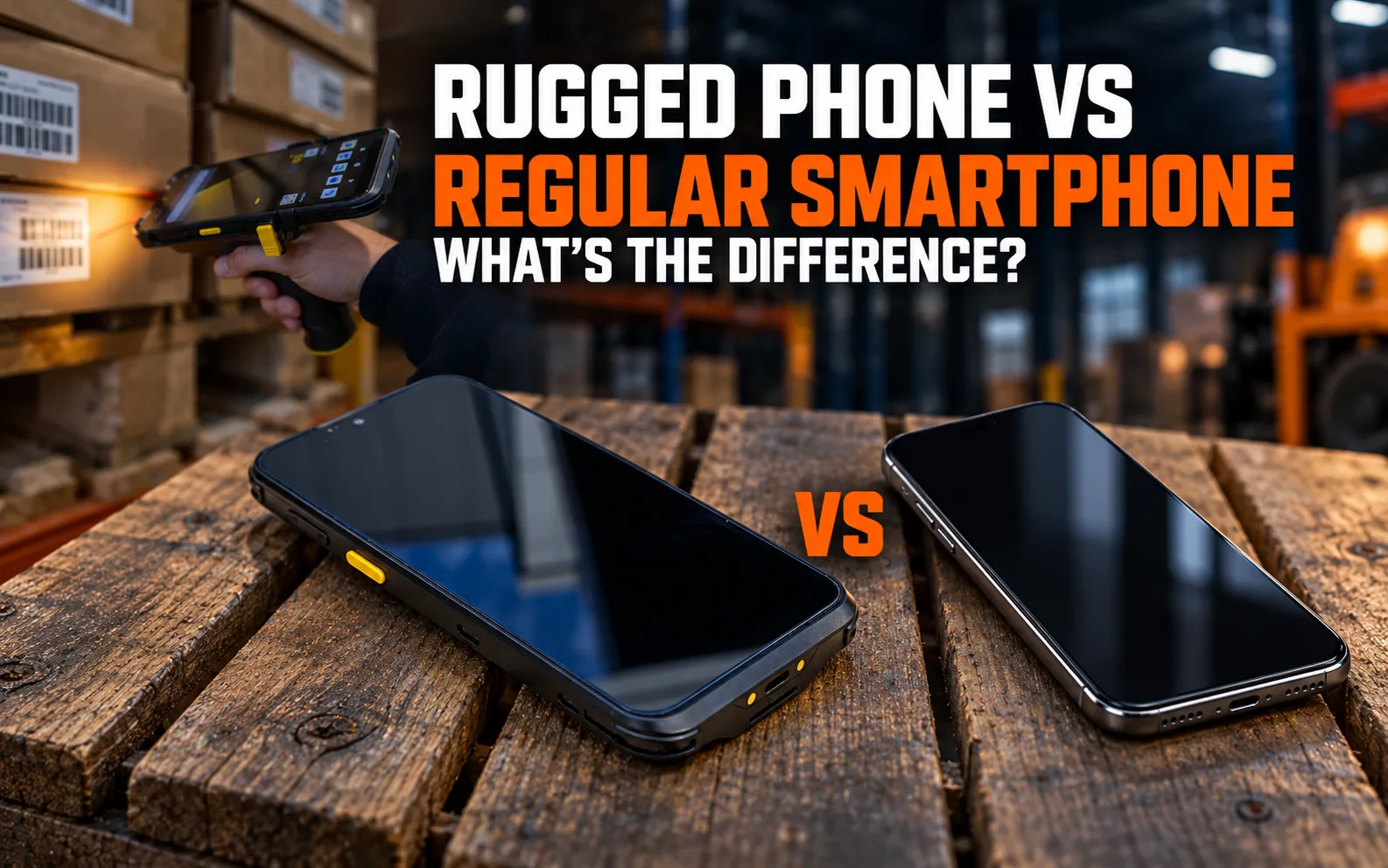
A rugged phone is built and tested to survive drops onto hard floors, dust, water and temperature extremes, and it usually adds work features a regular smartphone lacks, such as a built-in barcode scanner and programmable buttons. Regular smartphones have closed some of the gap: the iPhone 17 is rated IP68, but Apple excludes liquid damage from its warranty and designs the phone for 0°C to 35°C. For office staff, a regular smartphone does the job. For people who work in a warehouse, on site or in a van all shift, a 2015 VDC Research study found rugged smartphones cost 46% less to own.
On this page:
- What makes a phone rugged?
- How does a rugged phone compare with a regular smartphone?
- Aren’t regular smartphones tough enough now?
- What does a rugged phone add for work?
- Which costs less over its life?
- Who should stick with a regular smartphone?
- Who needs a rugged phone?
- Are budget rugged phones from online marketplaces good enough for a business?
- Which Conker rugged phone fits which job?
- Frequently asked questions
What makes a phone rugged?
“Rugged” is not a regulated term. Any manufacturer can print it on a box, so the test results matter more than the label.
Three tests do most of the work. An IP rating, defined by the international standard IEC 60529, measures protection against dust and water. A drop test shows the height from which the phone survived falls onto a hard surface, often run to methods in the US military standard MIL-STD-810. An operating temperature range tells you where the phone keeps working, not only where it survives storage.
The construction follows from those tests. Rugged phones use a thicker frame that sits proud of the screen, so the frame hits the floor first. Ports are sealed or covered. The glass is thicker, and the internals are mounted to absorb shock rather than pass it to the board.
When you compare models, ask for the drop height, the surface it was dropped on and the number of drops. A phone that survived one drop onto plywood tells you less than one that survived repeated drops onto concrete.
How does a rugged phone compare with a regular smartphone?
The table compares the iPhone 17, as a current flagship, with Conker’s rugged phones.
|
Regular smartphone (iPhone 17) |
Conker rugged phone |
| Water and dust |
IP68, up to 6 metres for 30 minutes, per Apple |
IP68 on the SX55, IP67 on the SX65 |
| Liquid damage |
Not covered under Apple’s warranty |
Covered as accidental damage on RELAX Plus |
| Drops |
No published drop rating |
1.5 metres on the SX55 [insert SX65 drop height] |
| Operating temperature |
0°C to 35°C, per Apple |
[insert range from datasheets] |
| Barcode scanning |
Camera plus an app |
Newland 2D scan engine on the SX65, Zebra 2D on the SX51 |
| Physical controls |
Volume, side and action buttons |
[confirm programmable keys per model]. The SX41 has a 26-key keypad. |
| Weight |
177g |
250g (SX55) |
| Warranty |
One year as standard, AppleCare+ at extra cost |
Three years with RELAX. UK repair centre, average repair under one working day in 2024. |
Aren’t regular smartphones tough enough now?
Tougher than they were, yes. Five years ago, IP68 was a premium feature. Today most flagship phones carry it, and screen glass has improved.
The gaps sit in three places.
The IP test uses still, fresh water in a lab. It doesn’t cover pressure washing, mud, oil, cleaning chemicals or salt water. Apple also states that water resistance is not a permanent condition and can decrease with normal wear.
Drops are the second gap. Flagship phones have glass on the front and back, and manufacturers don’t publish a drop rating. A case helps, but it adds bulk and still leaves the phone’s internals to absorb the shock.
The third gap is the warranty. If a regular phone survives a dunk but fails a month later, the repair falls outside the standard warranty. Your team pays for it, or you pay for an insurance plan on every device.
What does a rugged phone add for work?
The durability gets the attention, but the work features often decide the purchase.
A built-in scan engine reads barcodes when the user presses a trigger. A camera app works for a handful of scans a day, but it slows down on creased, curved or poorly lit labels. If your team scans all day, see our comparison of the Zebra TC27 and Conker SX65.
Programmable side keys can open the scanner, launch an app or act as a push-to-talk button for a walkie-talkie app. That matters when a user is wearing gloves or has one hand on a trolley.
Rugged phones also support kit that consumer phones rarely do: multi-bay charging docks for shift changes, holsters, hand straps and wrist mounts. And they’re built to be managed as a fleet, with mobile device management that can lock a phone to a single work app.
Which costs less over its life?
A regular smartphone usually costs less to buy. The cost that matters for a business is what happens after.
In a study VDC Research ran for Kyocera, non-rugged phones failed more than three times as often as rugged ones in business use, and rugged smartphones had a 46% lower total cost of ownership. Each failure cost 170 to 200 minutes of lost work and IT support time. The study dates from 2015, but a December 2025 analysis by Dell using VDC’s cost model found the same three-to-one failure gap.
For a team of 25, VDC’s first-year failure rates of 10% to 23% for non-rugged devices and 4% to 7% for rugged devices work out at three to six failures a year against one or two. At 170 minutes each, that’s 8 to 17 hours of lost time a year against 3 to 6, before you count replacement phones and the setup each one needs.
Conker records a 1.5% failure rate over three years across its devices. You can run your own figures through the Conker TCO calculator.
Who should stick with a regular smartphone?
If a phone spends its day in an office, a car or a meeting room, a regular smartphone is the better buy. It’s lighter, has a better camera and screen, and runs the same apps. Sales staff, managers and office-based teams rarely need anything more.
A regular phone also suits a bring-your-own-device policy, where staff use their personal phone with a work profile.
Who needs a rugged phone?
The test is where the phone spends its working day, and how often it leaves someone’s hand.
Warehouse and distribution teams drop phones onto concrete, work in chillers and scan all shift. Delivery drivers use the phone in rain, in and out of a van, for proof-of-delivery photos and signatures. Construction, utilities and field engineers deal with dust, mud, ladders and cold mornings. Kitchens, cleaning teams and food production face water, steam and cleaning chemicals.
If one of those describes your team, compare the cost of a rugged phone with the cost of replacing regular phones every year, not with the price of one regular phone.
Are budget rugged phones from online marketplaces good enough for a business?
You’ll find plenty of low-cost rugged phones from consumer brands online. Some are tough. For one user, one might be a fair buy.
For a fleet, check four things before you order: how long the manufacturer commits to security updates, whether the phone works with your MDM through Android Enterprise, where it goes for repair, and whether you can buy the same model again in a year. A phone that drops out of production after six months leaves you with a mixed fleet, and our post on the risks of mixed device fleets covers what that costs IT.
Which Conker rugged phone fits which job?
Field staff who call, message and take photos. The Conker SX55 is a pocket-sized 5.7-inch Android phone, sealed to IP68, drop-tested to 1.5 metres and weighing 250g. The product page lists it at £299.
Teams that scan all day. The Conker SX65 has a 6.5-inch screen, Android 14, 8GB of memory, a Newland 2D scan engine, 5G and Wi-Fi 6.
Gloved hands and fast data entry. The Conker SX41 adds a 26-key keypad to a 4-inch Android handheld.
Windows apps. The Conker NS65 runs Windows 11 on a 6.5-inch handheld, for teams whose software won’t run on Android.
Hands-free work. A rugged watch such as the WC4 straps a 4-inch Android screen to the wrist.
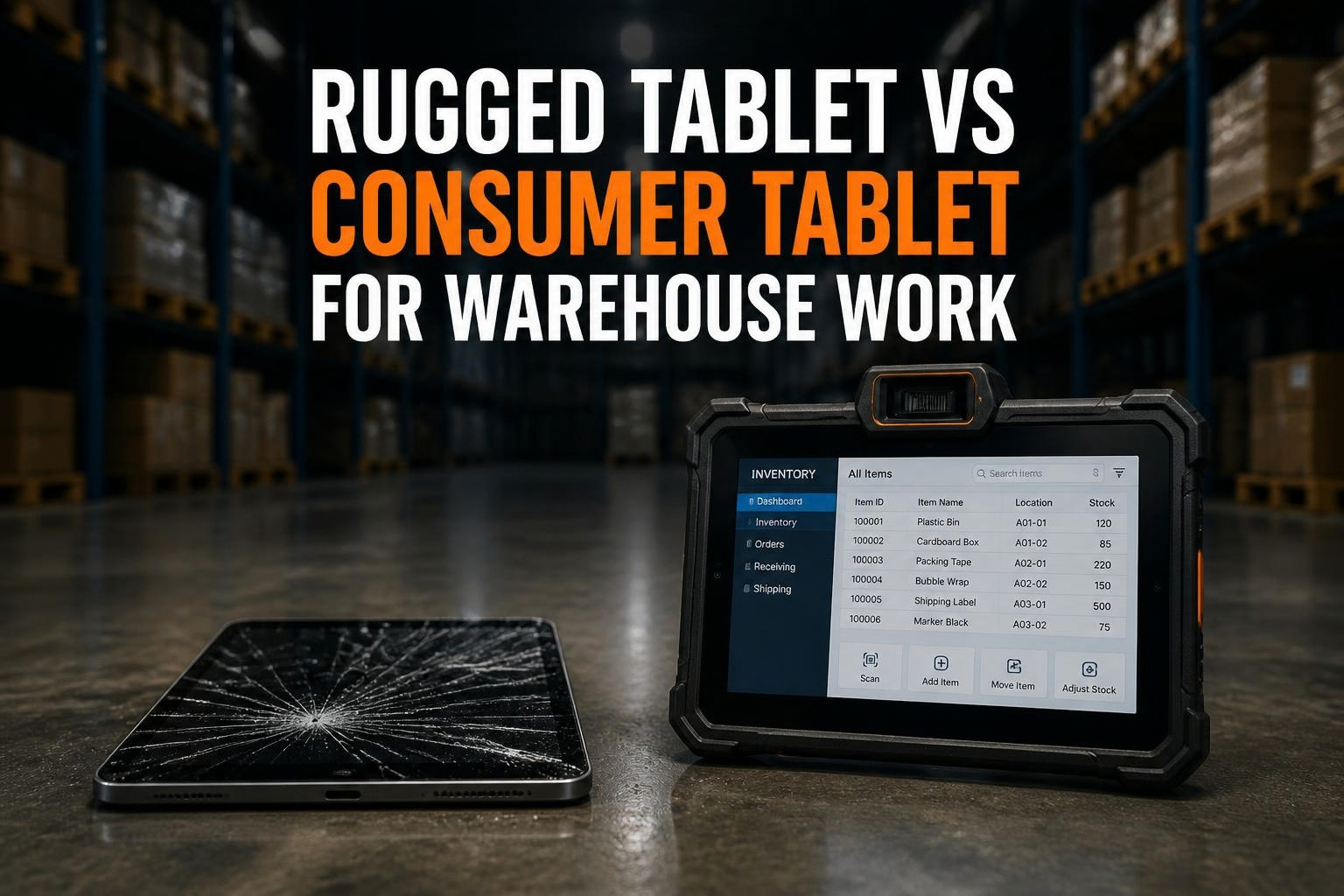
Every Conker device comes with a three-year RELAX warranty. RELAX Plus adds accidental damage cover with zero surcharges, free collection and three years of battery cover. For a ranked list across brands, see our top 10 rugged smartphones for business. For tablets, read rugged tablet vs consumer tablet for warehouse work.
Five questions to answer before you buy
- Where does the phone spend most of its working day?
- How many times a shift does it leave someone’s hand?
- Does the job need a barcode scanner, or only calls, messages and photos?
- How long do you expect each phone to last before you replace it?
- Will you need to order the same model again next year?
If you’d like help with the answers, book a project scoping call and we’ll match you with a consultant for your industry.
Frequently asked questions
Is a rugged phone waterproof?
Most rugged phones carry an IP67 or IP68 rating. IP67 covers immersion to 1 metre for 30 minutes, and IP68 covers deeper or longer immersion as the manufacturer specifies. Neither rating covers pressure jets or salt water unless the manufacturer tested for them.
Can I put a regular smartphone in a rugged case instead?
A rugged case protects the glass and the corners. It doesn’t add a scan engine, widen the operating temperature range or change the warranty, and liquid damage stays excluded on phones such as the iPhone 17.
Are rugged phones heavier than regular smartphones?
Usually, yes. The Conker SX55 weighs 250g, against 177g for the iPhone 17. A regular phone in a heavy-duty case closes much of that gap.
Do rugged phones run the same apps?
Android rugged phones run Android apps, including Microsoft Teams, WhatsApp and most warehouse and delivery apps. Windows handhelds such as the Conker NS65 run Windows software.
How long does a rugged phone last?
Conker covers its phones for three years under the RELAX warranty. How long a fleet lasts in practice also depends on how long the manufacturer keeps the model in production and supports it with security updates.