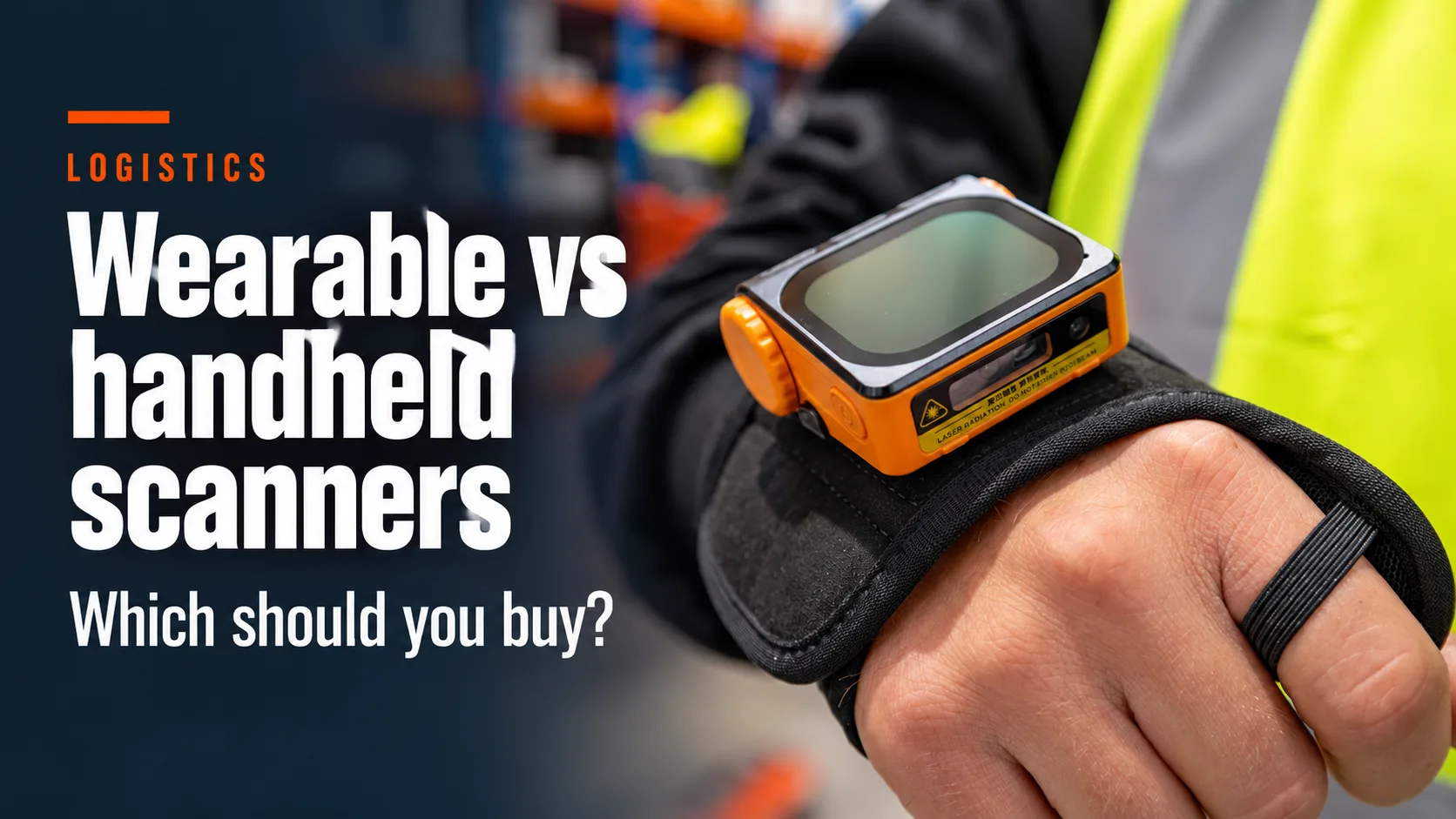
Logistics wearable scanning devices are barcode scanners and small computers worn on the hand or wrist, so the person scanning keeps both hands free for parcels, totes and cartons. They save the most time in picking, packing and sortation, where a handheld gets picked up and put down hundreds of times a shift. In a VDC Research survey commissioned by ProGlove, adopters reported order fulfilment 32.3% faster after switching to wearables. A handheld is still the better tool when the job needs typed quantities, photos, signatures or only a few scans an hour.
On this page:
- What counts as a wearable scanning device?
- How do wearable scanners compare with handhelds?
- Where do wearables save time in logistics?
- Do wearables reduce strain on pickers?
- Can staff use a phone and a ring scanner instead?
- Which costs less over its life?
- When is a handheld the better choice?
- Which Conker wearable fits which job?
- What happens when a wearable breaks?
- Six questions to answer before you buy
- Frequently asked questions
What counts as a wearable scanning device?
Three kinds of device turn up in logistics.
A glove scanner, also called a back-of-hand scanner, puts a scan engine in a small housing that clips into a work glove. The picker presses a trigger with the thumb. Most glove scanners have no screen and send each scan over Bluetooth to a host device: a handheld, a tablet, a vehicle-mounted computer or a wrist computer.
A ring scanner does the same job from a finger. We compare the two in glove scanner vs ring scanner.
A wrist or arm computer straps an Android screen to the forearm. It runs the warehouse management app, shows the next pick and receives scans from the glove.
Most logistics teams pair two of these: a glove for the scan and a wrist or pocket computer for the task list. That pairing is the main difference from a handheld, which scans and runs the app in one unit.
How do wearable scanners compare with handhelds?
The table compares Conker’s wearable range with the Conker SX65 handheld. Specs and list prices come from the Conker store in October 2026.
|
Glove scanner (BG series) |
Glove scanner with screen (BG3) |
Wrist computer (WC4) |
Handheld (SX65) |
| What it does |
Scans and sends to a host |
Scans and shows the result on a 2-inch screen |
Runs the app on a 4-inch screen |
Scans and runs the app in one unit |
| Hands free |
Yes |
Yes |
Yes, paired with a glove |
No |
| Weight |
45g |
125g |
273g |
285g |
| Scan engine |
1D, 2D or long-range 2D |
2D |
None |
Newland CM60 2D |
| Water and dust |
IP65 |
TBC |
IP65 |
IP67 |
| Drop test |
1.5 metres |
1.5 metres |
1.5 metres |
1.5 metres |
| Battery |
550mAh, swappable, up to 15 hours |
2,600mAh, removable, up to 9 hours |
2,850mAh, swappable |
5,000mAh, swappable |
| Operating system |
None |
Android 14 |
Android 10 |
Android 14 |
| List price |
£359 to £909 |
£949 |
£899 |
£789 |
Two rows deserve a closer look.
Weight. A BG glove scanner weighs 45g against 285g for the SX65. The picker still carries a host somewhere, but on the wrist or in a holster it isn’t in the hand that lifts the box.
Water and dust. Under the international standard IEC 60529, IP65 means dust-tight and protected against water jets. IP67 adds immersion to 1 metre for 30 minutes. A glove scanner rarely goes underwater. Rain on a loading bay and a wipe-down at the end of a shift are the real tests, and IP65 covers both.
Where do wearables save time in logistics?
Follow one picker through a shift with a handheld. Walk to the location. Take the handheld out of the holster. Scan the location. Hold the handheld, or put it down on the tote. Pick the item. Pick the handheld up again. Scan the item. Holster it. Walk on.
With a glove scanner, the thumb fires the scan while the hand is already on the item. The pick-up and put-down steps disappear, and on a pick path with hundreds of scans those steps add up.
The VDC Research survey commissioned by ProGlove asked adopters what changed. They reported order fulfilment 32.3% faster, picking and packing accuracy 27.2% higher, and 85% said they reached a return on investment within eight months. Those are self-reported figures from companies that chose to buy wearables, published by a wearable maker. Treat them as the upper end of what adopters see, not a forecast for your site.
The jobs that gain most:
- Each and case picking, where every pick needs a scan.
- Packing benches, where both hands handle the carton and the scanner stays on the glove.
- Parcel sortation and induction, with a scan for every parcel that passes.
- Trailer loading, where the box needs two hands and each one gets scanned on.
Goods-in with damage photos, cycle counts with typed quantities, and proof of delivery with a signature gain less. Those tasks keep a screen in the hand anyway.
Do wearables reduce strain on pickers?
The case for checking is strong. The Health and Safety Executive’s 2025 statistics put work-related musculoskeletal disorders at 511,000 workers in Great Britain in 2024/25, with 7.1 million working days lost. Transportation and storage ran at 1,800 cases per 100,000 workers over 2022/23 to 2024/25, against 1,180 across all industries. The upper limbs or neck accounted for 41% of cases.
We haven’t found a controlled study that shows wearable scanners cut these injuries. What a glove scanner changes is grip: the picker no longer holds a device while lifting, and 45g sits on the back of the hand instead of 285g in the palm.
Fit matters more than the spec sheet. Conker’s standard glove comes in small, medium and large, left or right handed. A PU leather glove wipes clean with alcohol wipes, an open-palm glove fits over other PPE, and an Alcantara glove carries a washable Omron trigger rated for 3 million presses. Trial them with your own team, including left-handers and people with small hands.
Can staff use a phone and a ring scanner instead?
For a short pilot, yes. For a fleet, the phone becomes the weak point.
Apple designs the iPhone for ambient temperatures from 0°C to 35°C. Freezers sit below that range, and a trailer in July can sit above it. Apple’s warranty also excludes liquid damage.
Failure rates follow. A VDC Research analysis for Dell, published in January 2025, found non-rugged devices fail three times as often as rugged ones. An earlier VDC study for Kyocera put each failure at 170 to 200 minutes of lost work and IT support. When the host fails, the glove scanner paired to it stops too.
Which costs less over its life?
A wearable setup costs more to buy. The glove scanner sits on top of a host device, so the question is whether the time it saves pays for it.
Here is a worked example for 30 pickers. The scan count and the time saved per scan are assumptions: replace them with figures from your own pilot.
|
Figure |
Basis |
| Pickers |
30 |
Example site |
| Added cost of glove scanners |
£10,770 to £27,270 |
30 at £359 to £909 list price |
| Scans per picker per shift |
1,000 |
Assumption |
| Time saved per scan |
1 second |
Assumption |
| Time freed per shift, whole team |
8.3 hours |
30 × 1,000 × 1 second |
| Time freed per year |
About 2,080 hours |
250 shifts |
At an example labour cost of £15 an hour, 2,080 hours is worth about £31,000 a year, against a one-off £10,770 to £27,270 for the gloves. Halve the saving per scan and payback still falls inside two years.
The catch: freed time only counts if it turns into more picks, a shorter shift or fewer agency hours. Measure it. Conker’s Scanning Performance Analytics software shows scans per device and per user, so you can compare a wearable team against a handheld team over the same weeks.
Downtime is the other half of the cost. Conker records a 1.5% failure rate over three years across its devices. You can run your own fleet size, failure rates and labour costs through the Conker TCO calculator.
When is a handheld the better choice?
Wearables are not the right answer for every logistics job. A handheld wins in five situations.
The task needs typing. Quantities, lot numbers and exception codes are faster on a 6.5-inch screen than on a wrist.
The task needs a camera or a signature. Damage photos at goods-in and proof of delivery at the door need a screen in the hand.
Scan counts are low. If a person scans a few times an hour, the time saved per scan never adds up to the cost of a second device.
Devices are shared across shifts. A glove scanner needs a glove that fits each user and gets cleaned. A handheld goes from one charger to the next person.
You want one device to manage. A glove plus a host means two batteries to charge, two devices to enrol in mobile device management and two things to lose.
For handheld options, see our guide to rugged handheld PDAs for warehouse operations and the Zebra TC27 vs Conker SX65 comparison.
Which Conker wearable fits which job?
High-volume each picking. The Conker BG2 2D glove scanner paired with the WC4 wrist computer keeps both hands free. Where pickers also key quantities, pair the BG2 with an SX65 in a holster instead.
Pallet and high-bay locations. The BG2L uses the Zebra SE5500 long-range engine, which reads labels up to 14.4 metres away, according to our wearables page.
Older 1D labels only. The BG1 uses a Zebra SE965 1D laser engine and is the lowest-cost option in the range.
Packing benches. A BG2 pairs with a desk tablet or panel PC, so the packer sees the order on a large screen and scans from the glove.
Scan checks without looking at a host. The Conker BG3 has its own 2-inch screen and runs Android 14, so the picker can confirm the scan on the back of the hand.
Light tasks and alerts on the wrist. The Conker SW9 weighs 100g, has a 2.8-inch screen and is rated IP67. Its battery is fixed, so it suits single shifts.
The transport and logistics and warehouse and distribution pages cover the wider device range for each setting.
What happens when a wearable breaks?
Every Conker device comes with a three-year RELAX warranty in one of three tiers:
| Tier |
What it covers |
| RELAX |
Return to base, hardware faults, unlimited fixed-rate repairs, 18-month battery warranty, five-day repairs at our UK repair centre |
| RELAX Plus |
Accidental damage cover, zero surcharges, free collect and return, battery faults and degradation covered for three years, one-day repairs |
| RELAX 360 |
Everything in RELAX Plus, plus on-site device swap-outs, device commissioning, end-of-life disposal with secure wipe, enhanced battery care and a priority SLA |
Our average repair time was under one working day in 2024. That is an average, not a guaranteed SLA.
Glove scanner batteries are user-swappable. A spare battery keeps a scanner running through a 24-hour operation, and the desk dock charges the scanner and a spare together. Conker MDM costs from £3.75 a month per device, and the fully managed MDM service costs from £4.17 a month with a four-hour SLA.
Six questions to answer before you buy
- How many scans does each person make per shift, and how many of those need a typed entry?
- What will the glove pair with: a wrist computer, a handheld, a tablet or a vehicle mount? Does your warehouse app run on it?
- Which barcodes do you scan: 1D only, 2D, or labels on high racking?
- What temperatures and wet areas does the kit see: chillers, freezers, the yard?
- How many shifts share each device, and how will you handle glove sizes and cleaning?
- How long will the host’s operating system receive security updates? Google’s Android Enterprise Recommended programme requires devices to publish security update end dates.
If you’d like help with the answers, book a project scoping call and we’ll match you with a consultant who works in logistics. We can also set up a trial so you measure scans per hour on your own pick paths before you commit.
Frequently asked questions
What is a wearable scanning device in logistics?
A wearable scanning device is a barcode scanner or small computer worn on the hand, finger or wrist. In logistics it lets pickers, packers and loaders scan items without picking up and putting down a handheld.
Are wearable scanners faster than handheld scanners?
For scan-heavy tasks such as picking and sortation, usually yes. Adopters in a VDC Research survey commissioned by ProGlove reported order fulfilment 32.3% faster. Measure your own gain in a pilot before rolling out.
Do wearable barcode scanners need a separate device?
Most do. The Conker BG series sends each scan over Bluetooth to a wrist computer, handheld, tablet or vehicle-mounted computer. The Conker BG3 has its own 2-inch screen and runs Android 14.
How long does a wearable scanner battery last?
The Conker BG series runs up to 15 hours on a removable 550mAh battery, and the BG3 runs up to 9 hours on a removable 2,600mAh battery. A spare battery covers 24-hour operations.
Can wearable scanners be used in cold stores?
The Conker BG series is rated IP65 and drop-tested to 1.5 metres. Check the operating temperature range against your chiller and freezer temperatures before you deploy.