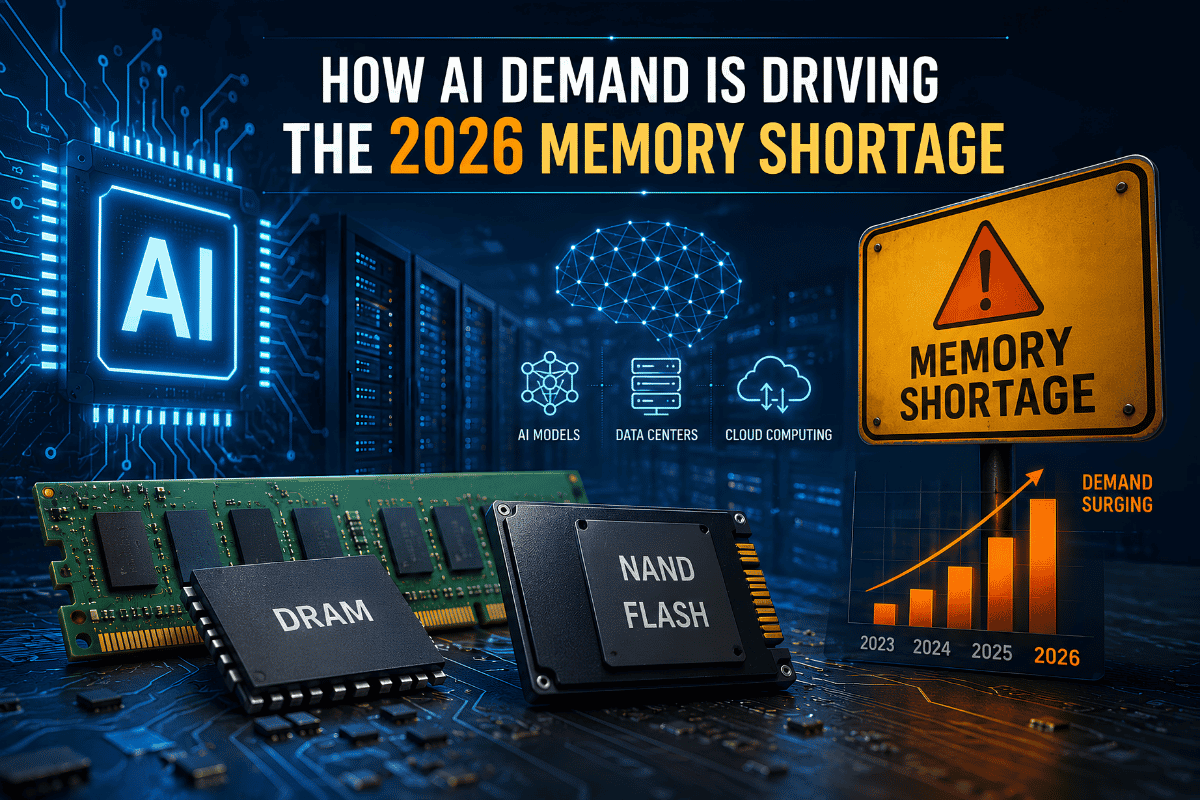
Artificial intelligence is transforming industries at an unprecedented pace. From generative AI and machine learning platforms to cloud computing and enterprise automation, organizations are investing heavily in AI-powered infrastructure.
While AI delivers remarkable innovation, it also creates enormous demand for computing resources. One of the biggest challenges emerging in 2026 is the growing shortage of memory technologies such as DRAM and NAND.
As AI adoption accelerates worldwide, memory manufacturers are struggling to keep pace with demand. The result is a market experiencing supply constraints, rising component costs, longer lead times, and growing procurement challenges.
For businesses that rely on enterprise hardware, rugged devices, industrial technology, and data-intensive systems, understanding the relationship between AI demand and memory shortages is becoming increasingly important.
Why Memory Has Become Critical in the AI Era
Artificial intelligence systems process enormous amounts of data.
To function effectively, AI workloads require:
- High-speed memory
- Large-scale storage
- Advanced processors
- Enterprise-grade infrastructure
DRAM and NAND memory play a crucial role in enabling these systems.
Without sufficient memory capacity, AI platforms cannot efficiently train models, process information, or deliver real-time responses.
As organizations expand AI initiatives, memory demand continues to increase across the global technology ecosystem.
Understanding DRAM and NAND Memory
Before exploring the shortage, it is important to understand the two memory technologies driving modern computing.
DRAM (Dynamic Random Access Memory)
DRAM is temporary memory used for active computing tasks.
It enables systems to:
- Process applications
- Run AI workloads
- Manage cloud infrastructure
- Handle real-time data operations
DRAM is found in:
- Servers
- Data centers
- Enterprise laptops
- Smartphones
- Industrial computers
- Rugged devices
NAND Flash Memory
NAND is long-term storage memory that retains data even when devices are powered off.
NAND is used in:
- SSDs
- Tablets
- Smartphones
- Enterprise storage systems
- Edge computing devices
- Industrial hardware
Together, DRAM and NAND form the foundation of modern digital infrastructure.
How AI Is Increasing Global Memory Demand
AI systems consume significantly more memory than traditional business applications.
Large language models, machine learning platforms, and generative AI tools require enormous datasets to train and operate.
These workloads demand:
- Faster memory access
- Larger storage capacities
- High-performance computing resources
As businesses deploy more AI solutions, memory consumption continues to rise rapidly.
This demand is becoming one of the primary drivers of the 2026 memory shortage.
Why AI Data Centers Need More Memory Than Ever
Modern AI applications are powered by hyperscale data centers.
These facilities host:
- AI training clusters
- Cloud computing platforms
- Enterprise applications
- Massive databases
Compared to traditional data centers, AI environments require significantly more DRAM and NAND memory.
A single AI training model can consume enormous amounts of memory capacity during development and deployment.
This increasing demand is creating pressure throughout the semiconductor supply chain.
What Is Causing the 2026 Memory Shortage?
A single factor does not cause the memory shortage.
Instead, multiple trends are converging simultaneously.
AI Infrastructure Expansion
Technology companies are investing billions into AI infrastructure.
Every new AI deployment increases demand for:
- Memory modules
- Storage systems
- Advanced servers
- High-performance computing equipment
Semiconductor Production Constraints
Memory manufacturing is highly specialized and requires significant investment.
Building new semiconductor fabrication facilities takes years.
As demand rises faster than production capacity, shortages emerge.
Global Supply Chain Challenges
Shipping delays, logistics disruptions, and geopolitical uncertainty continue to affect semiconductor distribution.
These issues further limit memory availability.
Growing Enterprise Demand
AI is no longer limited to technology companies.
Healthcare providers, manufacturers, logistics organizations, and financial institutions are all adopting AI-driven systems.
This broad adoption accelerates memory consumption across industries.
How Memory Shortages Affect Device Manufacturing
Memory shortages impact far more than AI infrastructure.
Many business-critical devices rely on DRAM and NAND availability.
This includes:
- Laptops
- Tablets
- Smartphones
- Industrial computers
- Rugged devices
- Enterprise mobility hardware
As memory becomes harder to source, manufacturers face increased production challenges.
Businesses often experience longer wait times and reduced device availability.
Rising Hardware Costs Across Industries
One of the most visible effects of memory shortages is rising hardware pricing.
Manufacturers facing higher component costs often pass these increases to customers.
Organizations are seeing higher prices for:
- Enterprise laptops
- Servers
- Rugged tablets
- Handheld scanners
- Mobile computers
- Storage systems
For businesses managing large technology fleets, these increases can significantly affect procurement budgets.
Impact on Enterprise Mobility and Rugged Devices
Enterprise mobility solutions depend heavily on reliable memory components.
Rugged devices used by frontline workers require:
- Processing power
- Storage capacity
- Connectivity performance
- Real-time application support
As memory shortages continue, manufacturers face increasing challenges in maintaining consistent production.
Businesses researching rugged device trends to watch are closely monitoring how memory availability may influence future device procurement.
Why Frontline Operations Feel the Impact
Frontline industries often experience hardware shortages before other sectors.
Warehouse workers, field service technicians, delivery drivers, and healthcare professionals rely on mobile technology to perform daily tasks.
When devices become difficult to replace, organizations may face:
- Workflow disruption
- Reduced productivity
- Increased downtime
- Delayed deployments
This reinforces the role of rugged devices in the supply chain industry, where reliable hardware remains essential for operational continuity.
How AI Demand Is Affecting Supply Chains
AI demand influences multiple layers of the supply chain.
Increased memory consumption affects:
- Semiconductor manufacturers
- Hardware producers
- Distributors
- Enterprise procurement teams
This creates a ripple effect throughout global technology markets.
Businesses relying on predictable procurement cycles are finding it increasingly difficult to forecast hardware availability.
Why Long-Term Procurement Planning Matters
Reactive purchasing strategies become risky during periods of component shortages.
Organizations should focus on:
- Lifecycle planning
- Hardware standardization
- Inventory forecasting
- Supplier diversification
- Strategic procurement
These practices help reduce exposure to supply disruptions.
Companies that plan often experience fewer operational challenges during periods of market volatility.
How Businesses Can Reduce Memory-Related Supply Risks
While organizations cannot directly control memory production, they can take steps to improve resilience.
Standardize Hardware Fleets
Standardized device environments simplify procurement and support processes.
Build Strong Supplier Relationships
Reliable vendor partnerships improve visibility and hardware availability.
Forecast Demand Earlier
Businesses should plan procurement well before deployment deadlines.
Maintain Spare Inventory
Backup devices help minimize disruption when replacements are delayed.
Invest in Durable Hardware
Long-lasting devices reduce replacement frequency and procurement pressure.
The Growing Importance of Rugged Technology
Many organizations are increasing investments in rugged devices because of their durability and extended lifecycles.
Rugged technology helps businesses:
- Reduce replacement costs
- Improve operational uptime
- Extend hardware longevity
- Lower procurement frequency
Companies evaluating how to choose the Best Rugged Devices are increasingly prioritizing lifecycle support and long-term reliability.
How Conker Helps Businesses Navigate Hardware Challenges
Conker helps organizations manage enterprise mobility challenges through rugged technology solutions and lifecycle support services.
Learn more about how it can support reliable device deployment, reduce downtime, and improve long-term operational resilience.
These solutions help businesses improve resilience during periods of hardware supply uncertainty.
Future Outlook for AI and Memory Markets
AI adoption is expected to continue accelerating throughout the remainder of the decade.
Future trends include:
- Increased AI infrastructure investment
- Larger data centers
- Growing enterprise AI adoption
- Expanded semiconductor manufacturing
- Continued memory demand growth
Although new production facilities may improve supply over time, memory demand is likely to remain elevated.
Businesses should prepare for ongoing market fluctuations and procurement challenges.
Conclusion
AI is rapidly becoming one of the biggest drivers of global memory demand.
As organizations invest in AI infrastructure, the demand for DRAM and NAND memory continues to grow faster than production capacity.
The resulting memory shortage is affecting hardware pricing, device availability, procurement planning, and enterprise mobility strategies worldwide.
Businesses that focus on lifecycle planning, hardware standardization, supplier partnerships, and durable technology investments will be better positioned to navigate ongoing market uncertainty.
The 2026 memory shortage is not simply a technology issue; it is becoming a strategic business challenge that requires proactive planning and long-term thinking.
Frequently Asked Questions (FAQs)
1. What is causing the 2026 memory shortage?
The shortage is primarily driven by rising AI demand, semiconductor production constraints, growing enterprise technology adoption, and ongoing supply chain disruptions.
2. What are DRAM and NAND memory technologies?
DRAM is high-speed temporary memory used for active computing tasks, while NAND is permanent storage memory used for data retention.
3. Why does AI require so much memory?
AI systems process large datasets and complex computations that require significant DRAM and storage capacity to function efficiently.
4. How do memory shortages affect hardware prices?
Limited memory availability increases component costs, which often leads to higher prices for enterprise devices, servers, and storage systems.
5. Which industries are most affected by memory shortages?
Industries including AI, cloud computing, logistics, healthcare, manufacturing, enterprise mobility, and industrial automation are significantly affected.
6. How does Conker help businesses manage hardware supply challenges?
Conker helps businesses through rugged hardware procurement, lifecycle management, mobility deployment, and enterprise mobility support services.
7. What rugged solutions does Conker provide?
Conker provides rugged tablets, handheld scanners, industrial laptops, wearable devices, mobile printers, and enterprise mobility solutions.
8. How can businesses reduce memory-related procurement risks?
Businesses can reduce risk through lifecycle planning, supplier partnerships, hardware standardization, inventory forecasting, and investing in durable technology.